If your band saw cuts mild steel without trouble but produces wandering cuts, premature blade failure, or discolored workpieces when you switch to titanium or Inconel, the problem may not be your blade. These materials expose weaknesses in blade guide systems that remain invisible during less demanding work. Before purchasing new blades or adjusting feed rates, consider whether your guides are providing the lateral support and thermal stability that difficult-to-machine alloys require.
This article explains the relationship between material properties and blade guide demands. Understanding this connection gives you a framework for diagnosing guide-related problems and deciding whether an upgrade to a precision guide system addresses your actual cutting difficulty.
What Makes Titanium and Superalloys Different
Three material properties combine to create unusual stress on blade guides. First, titanium and nickel-based superalloys have low thermal conductivity. Unlike aluminum or steel, they do not conduct heat away from the cutting zone efficiently. The blade and the immediate cut area absorb most of the thermal energy, which accelerates blade wear and can distort guide components designed for cooler operation.
Second, these alloys work-harden rapidly. When the blade deflects even slightly and rubs rather than cuts, the surface layer becomes harder than the parent material. On the next pass, the blade encounters this hardened layer, deflects again, and the cycle intensifies. Guides that allow lateral movement initiate this damaging feedback loop.
Third, cutting forces are higher. Titanium’s strength-to-weight ratio means the blade must work harder to remove material, and that load transfers directly to the guide bearings. Guides with inadequate bearing capacity or excessive clearance cannot maintain blade position under these forces.
What Blade Guides Actually Do During a Cut
Blade guides serve three functions that become more important as material difficulty increases. Lateral support prevents the blade from deflecting sideways under cutting pressure. The guide blocks or bearings positioned on either side of the blade resist the forces trying to push it off its intended path. When lateral support fails, cuts wander and blade fatigue accelerates.
The thrust bearing supports the back edge of the blade against the pressure of feeding into the workpiece. Without adequate thrust support, the blade can be pushed backward in the guides, changing the effective cutting angle and increasing friction.
Clearance management refers to the gap between guide components and the blade body. Too much clearance allows deflection; too little creates friction and heat. The ability to set and maintain precise clearance becomes a distinguishing feature in demanding applications where tolerances tighten.
How M71 Guides Address These Demands
The M71 blade guide configuration is designed with tighter tolerances and more stable bearing arrangements than standard guide systems. While specific design details vary by manufacturer and should be confirmed before purchase, guides in this class typically feature bearing materials selected for thermal stability and adjustment mechanisms that allow precise clearance settings.
The principle is straightforward: if the guide can maintain its position and clearance under elevated temperature and higher cutting forces, the blade remains supported through conditions that would cause standard guides to allow deflection. For operators working with titanium and superalloys, this means the guide system stops being a limiting factor in cut quality.
Note that this is a design characteristic statement, not a guaranteed outcome. The benefit materializes only when other system variables are within acceptable ranges, which the following sections address.
A Conceptual Example: Lateral Support and Work Hardening
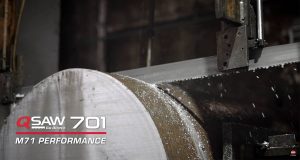
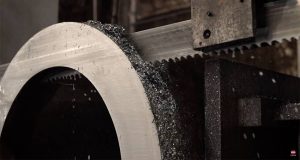
Consider cutting a 3-inch diameter titanium bar. At the entry point, the blade engages the full width of the material. Cutting forces peak, and the blade experiences maximum lateral pressure. With standard guides that have worn or were never designed for this load, the blade deflects perhaps 0.002 inches to one side.
This deflection seems minor, but it changes the cutting geometry. The blade teeth no longer engage cleanly; they rub and compress the surface instead of shearing it. The rubbed area work-hardens. As the blade continues around the wheel and returns for the next pass, it encounters hardened material at slightly different positions, causing irregular loading and further deflection.
Within a few inches of cut, the blade is working against both the original material and the work-hardened zones it created. Heat builds because cutting efficiency dropped. The operator sees a wandering cut, hears labored cutting sounds, and eventually experiences premature blade failure. A guide system that eliminated that initial 0.002-inch deflection would have prevented the entire sequence.
Setup Requirements for Guide Benefits to Materialize
Upgrading to M71 guides will not improve cutting if other system components are inadequate. The following assumptions must hold for precision guides to deliver their potential benefit.
Machine rigidity: The saw frame and wheel bearings must be in good condition. Guides cannot compensate for a machine that vibrates or has worn main bearings. If the entire blade path is unstable, improved guide precision addresses only one source of movement.
Blade tension: Proper tension keeps the blade straight between the wheels. Under-tensioned blades will still deflect between guides regardless of guide quality. Over-tensioned blades fatigue faster. Follow manufacturer specifications for the blade width you are using.
Coolant delivery: Titanium and superalloys require effective coolant to manage the heat that their low thermal conductivity traps at the cut. Guides positioned correctly still benefit from coolant reaching the blade and guides to maintain thermal stability.
Guide adjustment: Precision guides only work when adjusted precisely. If you set M71 guides with the same casual approach used for standard guides, you will not realize their capability. Plan for more careful setup time.
When M71 Guides Will Not Solve the Problem
Operators sometimes attribute all cutting difficulties to one component. Guide upgrades address guide-related problems, but several common issues have other causes.
| Symptom | Possible Guide Cause | Possible Other Cause |
| Wandering cuts | Lateral deflection from worn or inadequate guides | Dull blade, incorrect tooth pitch, excessive feed rate |
| Premature blade failure | Fatigue from deflection cycles | Wrong blade type for material, improper tension, coolant failure |
| Rough surface finish | Blade vibration from guide clearance | Feed rate too high, blade too coarse for application |
| Excessive heat at cut | Guide friction from improper clearance | Coolant not reaching cut, speeds and feeds mismatch |
If your current guides are properly adjusted and in good condition but symptoms persist, the guides may not be the limiting factor. Blade selection, machine condition, or cutting parameters might be the actual cause. Upgrading guides in that situation costs money without solving the problem.
A Decision Framework for Guide Upgrades
Before purchasing M71 guides, work through this sequence to determine whether the upgrade addresses your actual situation.
1. Verify that the symptoms occur specifically with titanium, superalloys, or other difficult materials but not with easier materials. This suggests the guides cannot handle elevated demands.
2. Inspect current guides for wear, damage, or incorrect clearance settings. If standard guides are worn, replacing them with new standard guides may resolve the issue at lower cost.
3. Confirm that blade selection, tension, coolant, and feed rates are appropriate for the material. Eliminate these variables before concluding that guides are the limitation.
4. Assess machine condition. Upgrading guides on a saw with worn wheel bearings or frame issues will not deliver full benefit.
5. Estimate the value of the improvement. If you cut difficult materials frequently and current results are unacceptable, the upgrade may justify its cost. For occasional titanium work, improving setup practice with existing equipment might be sufficient.
Transferable Principles for Evaluating Any Guide System
The M71 discussion illustrates broader principles applicable whenever you assess blade guides for demanding materials. Higher cutting forces require guides with greater bearing capacity and more rigid construction. Materials with low thermal conductivity require guides that maintain dimensional stability at elevated temperatures. Materials prone to work hardening require guides that minimize any blade deflection.
When evaluating any guide system, ask what material properties will test its limits. A guide adequate for aluminum may fail with stainless steel; one adequate for stainless may fail with titanium. Match guide capability to the most demanding material you expect to cut regularly, not the average case.
Finding More Information
For specifications on blade guides and their compatibility with specific band saw models, consult manufacturer documentation or contact a technical representative. Material-specific cutting recommendations, including blade selection and feed rate guidance for titanium and superalloys, are available through technical resources at sawblade.com. These sources can help confirm whether the M71 configuration fits your machine and application before you commit to a purchase.