When you see M42, M51, or M71 on a bimetal bandsaw blade, the label refers to the high-speed steel welded onto the tooth tips, not the flexible backing steel or the tooth geometry. The practical question is whether paying more for a higher M-grade actually returns longer blade life in your specific application, or whether you’re buying heat resistance you’ll never use. The answer depends on how much thermal stress your cutting generates at the tooth edge, which is a function of material hardness, cutting speed, and feed pressure. Understanding the metallurgical differences lets you predict performance rather than guess.
What the M-Numbers Actually Mean
The M designation comes from the AISI classification for molybdenum-series high-speed steels. These alloys share a base of tungsten, molybdenum, and chromium, but differ primarily in cobalt content and the presence of additional carbide-forming elements like vanadium. Cobalt does not form carbides itself; instead, it dissolves into the steel matrix and raises the temperature at which the edge begins to soften.
M42 typically contains around 8% cobalt. M51 increases that to roughly 10% and often adds vanadium for finer carbide distribution. M71 pushes cobalt content higher still and incorporates additional tungsten and vanadium to create a denser carbide network. The exact percentages vary by manufacturer, so treat these figures as representative rather than universal. What matters for selection is the performance consequence: each step up the ladder raises the threshold temperature before the edge loses hardness.
Red Hardness and Why It Matters
Red hardness is the ability of a cutting edge to retain its hardness at elevated temperatures. The name comes from the color steel reaches at temperatures that cause standard carbon steels to soften. When a bandsaw tooth enters a cut, friction and plastic deformation of the workpiece generate heat concentrated at the tooth tip. If that heat exceeds the alloy’s red hardness threshold, the edge deforms plastically, rounds over, and loses its ability to shear metal efficiently.
Higher cobalt content raises this threshold. An M42 edge might begin losing hardness around 600°C, while M51 extends that window, and M71 extends it further. The practical implication is that you only benefit from higher red hardness when your cutting conditions actually generate those temperatures. Slow cuts through soft material never approach these thresholds, so the premium alloy provides no advantage.
M42: The Baseline for General Bimetal Use
M42 is the standard edge alloy for most bimetal bandsaw blades sold today. Its 8% cobalt content provides enough red hardness for the majority of structural steel, carbon steel tubing, and aluminum cutting performed on horizontal or vertical bandsaws at typical shop speeds. If you’re cutting mild steel bundles at 150 to 250 surface feet per minute, the tooth tip temperature stays well below the softening threshold, and M42 performs as well as any premium alternative.
M42 is also the most forgiving grade when interrupted cuts or bundled material cause impact loading. Higher-cobalt alloys trade some toughness for heat resistance, so in applications where teeth strip out from shock rather than wear down from heat, M42’s slightly greater fracture resistance can actually extend blade life. Operators who blame blade failure on material should check whether teeth are rounding or breaking before assuming they need an upgrade.
M51: When Additional Heat Resistance Pays Off
M51’s higher cobalt content and added vanadium carbides make it a better choice when cutting conditions generate sustained high temperatures at the tooth tip. This includes austenitic stainless steels, which work-harden and transfer heat poorly, sending more thermal energy into the blade edge rather than away with the chip. It also includes production environments running carbon steel at aggressive surface speeds to maximize throughput.
The cost premium for M51 over M42 is typically 15% to 30%. That premium is justified only when the blade life increase exceeds that percentage. If you’re cutting 304 stainless and your M42 blades dull after 50 cuts while M51 lasts 80 cuts, the math favors M51. If both grades fail at similar cut counts, the limiting factor is not red hardness, and the extra cost is wasted. Tracking actual blade life on consistent material is the only reliable way to know.
M71: High-Alloy Edge for Severe Applications
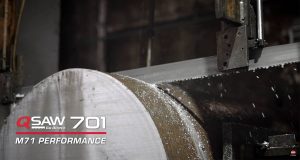
M71 represents the upper end of production bimetal blade technology. Its enhanced carbide network improves wear resistance in addition to red hardness, making it suitable for aerospace alloys like Inconel and Waspaloy, hardened tool steels, and high-volume production cells running at speeds that would rapidly degrade lesser alloys. Some manufacturers market M71 blades specifically for cutting materials above 35 HRC.
The tradeoff is brittleness. The dense carbide structure that resists wear also reduces fracture toughness, so M71 edges are more prone to chipping or tooth loss on interrupted cuts, structural bundles with gaps, or any application with significant impact loading. If your application involves variable cross-sections or shock, M71 may fail sooner than M42 despite its superior heat resistance. The grade excels only when heat is genuinely the limiting factor and the cut profile is consistent.
Worked Example: Selecting by Material and Speed
Consider two hypothetical shops. Shop A cuts bundles of A36 mild steel tubing at 180 SFPM on a semi-automatic horizontal saw. The material is soft, the feed pressure is moderate, and the interrupted nature of the bundle adds some shock loading. Heat at the tooth tip stays low. M42 is the rational choice; upgrading to M51 would increase cost without increasing blade life because the failure mode is likely mechanical fatigue or abrasive wear from mill scale, not thermal softening.
Shop B runs a production cell cutting 304 stainless bar at 280 SFPM with flood coolant. The stainless work-hardens, chips poorly, and directs heat into the blade. M42 edges round over quickly because the temperature exceeds their softening threshold. M51’s higher red hardness directly addresses this failure mode, and blade life improves enough to justify the price. If Shop B later increases speed further or switches to 17-4PH stainless, M71 might become worthwhile. The decision follows from matching the blade’s thermal capability to the actual temperature at the cut.
Matching Grades to Failure Modes
| Failure Mode | Likely Cause | Grade Implication |
| Teeth rounded and shiny | Thermal softening exceeded red hardness | Consider higher grade |
| Teeth chipped or stripped | Impact loading or brittle edge | Stay with M42 or improve setup |
| Back edge cracked | Guide misalignment or fatigue | Grade irrelevant; fix guides |
| Premature dulling on soft steel | Mill scale or abrasive surface | Grade unlikely to help; address coolant or speed |
This table summarizes how observed failure patterns connect to grade decisions. The principle is straightforward: upgrade only when heat is the limiting factor. When other failure modes dominate, spending more on red hardness wastes money that could go toward blade quantity, coolant improvements, or machine maintenance.
When Not to Upgrade
Operators sometimes assume that a more expensive blade is always better, but several common situations make upgrades pointless or counterproductive. Portable bandsaws rarely generate enough speed or sustained feed pressure to heat the edge meaningfully, so M42 is usually the best value. Soft aluminum alloys cut cold even at higher speeds because the material shears easily and conducts heat away from the cut. Intermittent hobby use means blades typically rust or fatigue before they wear out, making edge alloy irrelevant.
The clearest indicator that upgrading is unnecessary is blade life data showing no improvement. If you trial M51 against M42 on the same material and both fail at similar cut counts, something other than red hardness is limiting life. Common culprits include tooth strip-out from bundled material, back edge fatigue from misaligned guides, or chip loading from inadequate coolant. Solving those problems will extend blade life more than buying a premium alloy.
Are M71 Cobalt Alloy Blades Worth the Investment for Tough Metals?
Cutting work-hardening metals such as stainless steel, titanium alloys, and high-performance superalloys can put significant stress on conventional bandsaw blades, leading to premature tooth wear, reduced cutting efficiency, and frequent replacements. While M71 cobalt alloy blades typically come with a higher upfront cost, their performance characteristics may offer long-term advantages in demanding cutting applications. Our article, “M71 Blade Guide: When Cobalt Alloy Blades Justify Their Cost on Work-Hardening Metals,“ explores the conditions where investing in M71 blades makes practical and financial sense. Discover how material hardness, work-hardening behavior, cutting frequency, and blade longevity influence the overall cost per cut. Whether you’re machining difficult alloys regularly or evaluating an upgrade from conventional bi-metal blades, this guide will help you determine when M71 technology delivers measurable value and when a more economical blade may be sufficient.
Checking Your Own Results
The most reliable way to validate blade selection is to track blade life by grade on consistent material and cutting parameters. Record the number of cuts or square inches cut before blade change, the reason for change (dull, broken teeth, wandering cut), and the grade used. After accumulating data from several blade changes, patterns emerge. If M51 consistently yields 40% more cuts than M42 on your stainless work, the upgrade pays for itself. If the numbers are similar, the cheaper blade is the rational choice.
When examining worn blades, note whether the teeth are rounded and polished (thermal softening) or chipped and missing (impact or fatigue). Rounded teeth indicate that upgrading to a higher red hardness grade could help. Chipped teeth suggest the opposite: a tougher, lower-cobalt blade might actually last longer. For operators developing judgment that transfers to new materials and machines, this habit of examining failure modes is more valuable than memorizing brand recommendations. Additional guidance on blade failure analysis and material selection is available through bandsaw blade resources at Sawblade.com.
Transferable Principles
The logic behind M42, M51, and M71 selection applies to any high-speed steel blade specification you encounter. When evaluating an unfamiliar grade, look for cobalt content and carbide-forming elements. Higher cobalt means better red hardness but slightly reduced toughness. More vanadium or tungsten carbides improve wear resistance but may increase brittleness. These tradeoffs are universal in HSS metallurgy.
The practical test remains the same: does the blade last longer in your application, and does that improvement justify the price difference? Marketing language about premium alloys often obscures this simple calculation. By understanding what the M-numbers represent, operators can evaluate claims critically rather than accepting them at face value. For additional technical information on blade specifications and selection guidance, manufacturer documentation often provides alloy details that enable informed comparison.