Your blade dulled faster than expected. The cut surface shows heat discoloration. Instead of curled chips, you see fine metallic powder accumulating around the workpiece. Before replacing the blade or switching to a more aggressive tooth count, consider that the problem may not be the blade at all. When cutting stainless steel, the instinct to slow down and apply light pressure often creates the very condition that destroys cutting performance. Understanding why this happens, and how to recognize it early, lets you adapt your approach across different machines, blade types, and stainless grades rather than memorizing settings that may not transfer to your next job.
What Work Hardening Actually Is
Work hardening, also called strain hardening, occurs when mechanical stress rearranges the crystal structure at a metal’s surface. The atoms in the affected layer shift into positions that resist further deformation, making that layer harder than the unaffected material beneath it. This is a property of the workpiece itself, not something the blade does wrong.
Austenitic stainless steels, the 300 series grades like 304 and 316, are particularly prone to this behavior. Their crystal structure (face-centered cubic) allows atoms to shift and lock under stress more readily than ferritic or martensitic stainless types. A 304 stainless bar can increase in surface hardness by 50% or more when subjected to repeated rubbing or deformation. The hardening happens in the top few thousandths of an inch, but that thin layer is exactly where your blade teeth need to penetrate on the next pass.
How Sawing Triggers Work Hardening
Productive cutting happens when each tooth shears away a chip of material and carries it out of the cut. The tooth enters, engages, removes stock, and exits. Destructive rubbing happens when the tooth slides across the surface without penetrating deeply enough to form a chip. Instead of shearing, the tooth pushes and compresses the surface layer, generating friction heat and mechanical stress without actually removing material.
This distinction matters because rubbing delivers the worst combination: enough energy to deform the surface, but not enough penetration to remove the deformed material. The surface layer hardens. On the next pass, the teeth encounter this harder layer and, if feed pressure remains insufficient, rub again at a slightly shallower depth. The hardened zone grows thicker and harder. Each pass makes the next pass more difficult until the blade cannot cut at all.
The cycle accelerates once it begins. A blade that starts cutting well can transition into rubbing as the operator responds to increasing resistance by backing off pressure, which compounds the problem. Selecting an appropriate blade for stainless steel is important, and resources for industrial blade options can help with initial choices, but blade selection cannot overcome a technique that induces hardening.
Recognizing the Warning Signs
Work hardening gives observable signals before it destroys a blade. Learning to read these signs lets you adjust technique before significant damage occurs.
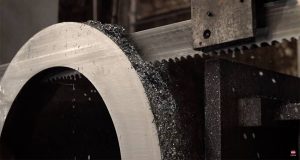
Chip appearance provides the clearest feedback. Healthy stainless cutting produces curled or segmented chips with some thickness. When you see fine powder, flaky particles, or discolored dust instead of formed chips, the teeth are rubbing rather than shearing. This means the surface is being work hardened with each pass.
Cutting resistance that increases progressively, even though nothing else changed, indicates a hardening surface layer. If the same material that cut smoothly five minutes ago now requires noticeably more force, the surface has likely hardened.
Blade glazing appears as a polished, shiny appearance on the tooth tips. This happens when rubbing friction heats the teeth enough to smooth their cutting edges without actually wearing away significant carbide. Glazed teeth lose their ability to bite into material.
Workpiece discoloration, particularly straw yellow or blue tints near the cut, indicates excessive heat generation. This heat accelerates work hardening and signals that the cutting action has shifted toward friction rather than shearing.
Squealing or chattering sounds often accompany rubbing conditions. The blade is skipping across the hardened surface rather than engaging smoothly. By the time you hear these sounds consistently, some hardening has already occurred.

Feed Rate: Why Hesitation Causes Damage
The counterintuitive principle of stainless cutting is that insufficient feed pressure often causes more damage than aggressive feed. Operators accustomed to mild steel or aluminum sometimes approach stainless cautiously, using light pressure and slow feed to avoid stressing the blade. This instinct, reasonable for other materials, backfires with austenitic stainless.
Each tooth needs to penetrate past the thin surface layer that the previous tooth may have slightly hardened. Light pressure keeps the teeth riding on that layer instead of cutting beneath it. The rubbing compounds, the layer thickens, and within minutes the blade faces material significantly harder than the original stock.
Consider two hypothetical approaches to the same cut. Operator A uses steady, committed feed pressure, maintaining consistent chip formation throughout. Operator B starts with light pressure, backs off when resistance builds, and allows the blade to dwell momentarily at transitions. Operator A’s blade stays sharp because it continuously shears fresh material. Operator B’s blade glazes and dulls rapidly because it repeatedly rubbed a hardening surface layer.
The practical guidance is to commit to each pass. Maintain feed pressure that keeps chips forming. If you must pause, retract the blade from contact rather than letting it sit against the workpiece. Hesitation in the cut, even for a few seconds, generates rubbing that triggers hardening.
Blade Speed and Heat Management
Surface speed, measured in surface feet per minute (SFM), determines how fast the blade moves across the workpiece. Higher speeds generate heat faster because more friction events occur per second. With stainless steel’s poor thermal conductivity, that heat concentrates at the cut rather than dissipating into the surrounding material. Excess heat accelerates work hardening by adding thermal stress to the mechanical stress already present.
The appropriate speed for stainless is generally lower than for carbon steel or aluminum. However, speed alone does not solve the problem if feed rate remains inadequate. Reducing speed while maintaining light feed creates slow rubbing instead of fast rubbing; the surface still hardens, just slightly more slowly.
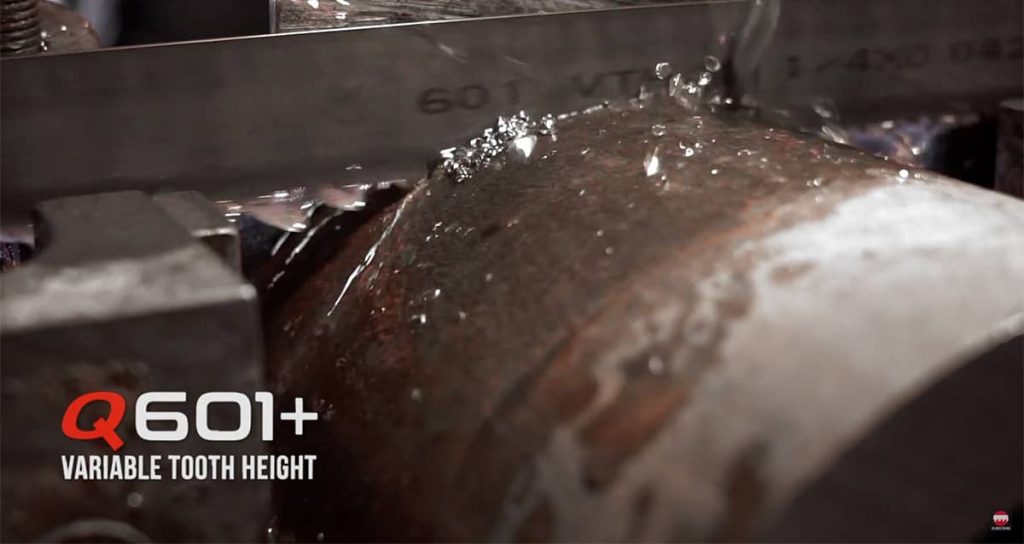
Coolant serves two functions relevant to work hardening. First, it removes heat from the cutting zone, limiting thermal contribution to hardening. Second, it lubricates the interface between tooth and workpiece, reducing friction during the brief moment when each tooth engages. Both functions help maintain productive chip formation rather than rubbing. For guidance on coolant application and cutting fluid considerations, the Sawblade.com site offers relevant information that may assist with fluid selection.
Flood coolant applied directly to the cut is more effective than mist for stainless because it carries heat away continuously. If coolant is not available, reducing speed becomes more important, and accepting slower production may be necessary to avoid blade destruction.
Choosing Blade Characteristics for Stainless
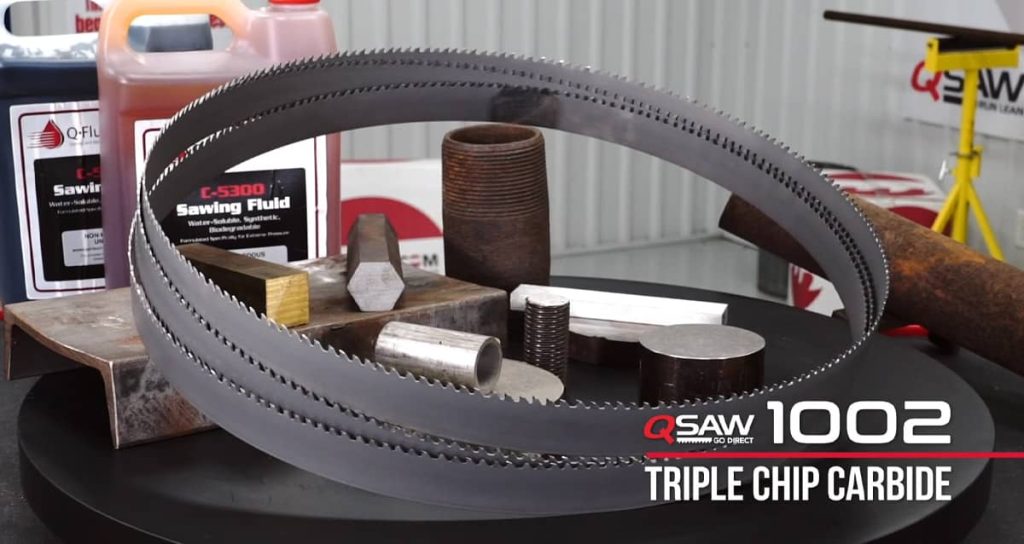
Tooth geometry affects whether the cutting action shears or pushes material. Positive rake angles, where the tooth face tilts forward in the cutting direction, promote shearing action that slices into the workpiece. Neutral or negative rake angles are more likely to push and compress, which increases deformation stress at the surface.
Tooth pitch, the spacing between teeth, determines chip clearance. With stainless steel’s tendency to produce stringy chips, adequate gullet space prevents chips from packing and re-cutting, which generates additional heat and rubbing. Too fine a pitch crowds chips; too coarse a pitch may leave too few teeth in contact for smooth cutting.
Blade selection matters, but it cannot compensate for technique problems. A premium blade designed for stainless will still fail if the operator dwells, uses insufficient feed, or runs excessive speed. Conversely, a general-purpose blade used with proper technique will outperform a specialized blade used poorly. Exploring options at Sawblade.com can help identify blades suited to stainless applications, though understanding the underlying principles remains more valuable than any single product choice.
Recovering from an Already Hardened Surface
Once work hardening has occurred, the affected layer presents a genuine obstacle. The hardened zone may be only a few thousandths of an inch thick, but it can be hard enough to resist the same blade that cut the original material easily.
One option is to increase feed pressure significantly to force teeth through the hardened layer into softer material beneath. This works when the hardened zone is thin and the blade still has sufficient sharpness. The risk is that a severely dulled blade cannot recover even with aggressive feed.
Another option is removing the hardened layer by a different process, such as grinding or machining, before resuming sawing. This adds steps but may save a blade that would otherwise be destroyed.
In severe cases, where hardening extends deeply or the cut has progressed far enough that the blade is glazed and ineffective, the practical answer may be to cut away the affected area and start fresh with a new blade and correct technique. Acknowledging this limitation honestly is more useful than pretending that every situation is recoverable. Sometimes the cost of forcing through hardened material exceeds the cost of scrapping a partial cut.
Transferring These Principles to Other Situations
The principles that prevent work hardening in 304 stainless apply to any material that strain hardens. Certain nickel alloys, some titanium grades, and precipitation-hardening stainless steels share this tendency. The specific speeds and feeds differ, but the underlying requirement remains: maintain chip formation by ensuring adequate penetration on every pass.
Across different machines (band saws, cold saws, horizontal and vertical configurations), the physics remain consistent. A tooth must remove material, not rub it. The feedback signals, chip appearance, cutting resistance, heat discoloration, and sound, remain valid indicators regardless of equipment type.
Developing the habit of observing chips provides ongoing feedback on technique. Healthy chips mean productive cutting. Powder or discolored particles mean rubbing and hardening. This observation skill transfers to unfamiliar materials and machines more reliably than memorized speed and feed charts, because it responds to actual cutting conditions rather than assumed ones.
Understanding cause and effect, why rubbing hardens the surface and why adequate feed prevents it, lets you troubleshoot problems you have not previously encountered. That understanding is more durable than any single recommended setting.