If you replace bandsaw blades on a rough schedule or whenever cuts start drifting, you may be discarding blades that could have lasted significantly longer, or keeping blades that were already compromised before visible problems appeared. The difference between a blade that fails at 20 hours and one that reaches 60 hours often comes down to controllable operating variables rather than blade quality or luck. Understanding why blades fail gives you something more useful than a maintenance checklist: the ability to examine a worn blade, identify what shortened its life, and correct that specific factor for the next one.
This matters because the same blade, on the same machine, cutting the same material, can degrade through completely different mechanisms depending on how you operate it. A blade that fails from heat damage requires a different correction than one that cracked from tension stress. Once you learn to read these patterns, you can transfer that understanding to any bandsaw, any material, and any blade type you encounter.
How Bandsaw Teeth Actually Wear
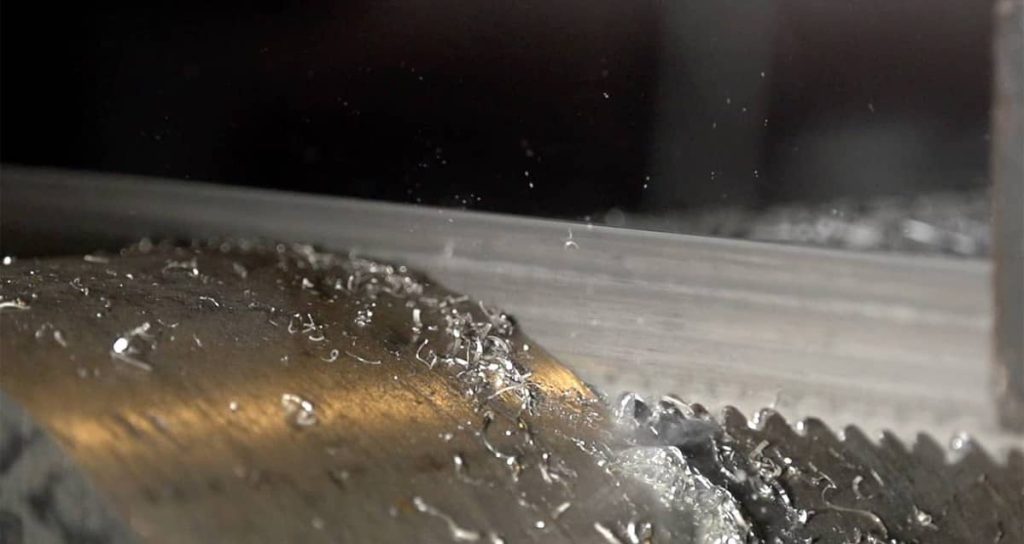
Tooth wear happens through two distinct mechanisms that look different and require different corrections. Abrasive wear occurs when hard particles in the workpiece physically grind away tooth material. This happens gradually and affects the cutting edge geometry in a predictable way: the sharp edge radius increases, requiring more feed pressure to maintain cutting action. Abrasive wear is largely unavoidable when cutting abrasive materials, and blade life becomes a function of tooth hardness versus workpiece hardness.
Thermal softening is the less obvious but often more destructive mechanism. When cutting generates enough heat that tooth tips exceed their tempering temperature, the steel loses hardness permanently. For carbon steel teeth, this begins around 400°F (204°C). Bi-metal blades with high-speed steel edges tolerate higher temperatures, roughly 1000°F (538°C), before softening begins. Once teeth soften, they wear at dramatically accelerated rates even in materials that would otherwise cause minimal abrasion.
The practical consequence is that heat damage often masquerades as a blade quality problem. An operator who consistently overheats blades through excessive speed or insufficient chip load will conclude that blades simply do not last, when the actual cause is thermal degradation occurring in the first few cuts. You can identify heat damage by discoloration (straw to blue tinting on tooth tips) and by the wear pattern: thermally damaged teeth show rounded, almost polished edges rather than the chipped or scratched appearance of abrasive wear. Selecting the right blade for your application starts with understanding these failure modes, and exploring blade options at Sawblade.com can help you match tooth material to your cutting conditions.
Gullet Cracks and Back Edge Fatigue
Every revolution around the bandsaw wheels subjects the blade to a complete stress cycle: the blade flexes as it wraps around the wheel, then straightens on the cutting span, then flexes again around the opposite wheel. This repeated bending concentrates stress at two locations. The gullet, where the tooth meets the blade body, experiences tension on the outer surface of the bend. The back edge, opposite the teeth, experiences compression and tension alternating with each wheel pass.
Fatigue failure occurs when accumulated stress cycles exceed the blade material’s endurance limit. Smaller wheel diameters force tighter bending radii, increasing stress per cycle. Higher blade tension adds static stress on top of the cyclic bending stress. The combination accelerates crack initiation. A blade running on 14 inch wheels at proper tension might survive hundreds of thousands of cycles, while the same blade on 6 inch wheels at excessive tension could develop gullet cracks in a fraction of that time.
You can identify fatigue-initiated cracks by their location and appearance. Gullet cracks typically start at the base of the gullet and propagate into the blade body, eventually causing tooth loss. Back edge cracks often appear as fine lines perpendicular to the blade length. If you find cracks but the teeth still look sharp, fatigue rather than wear ended the blade’s life. This tells you to examine tension settings, wheel condition, and whether the blade thickness is appropriate for your wheel diameter. Thicker blades resist wear but require larger wheels to avoid excessive bending stress.
Loss of Set and Blade Drift
Set refers to the alternating offset of teeth that creates a kerf wider than the blade body, providing clearance so the blade does not bind in the cut. When teeth lose their set, the blade begins to rub against the workpiece, generating friction heat and causing the blade to wander or drift rather than track straight.
Set loss occurs through asymmetric forces on the teeth during cutting. If feed pressure is uneven, if the workpiece contacts teeth on one side before the other, or if the blade guides allow lateral movement, teeth on one side experience greater bending stress and gradually deflect inward. Once set becomes uneven, the blade cuts a curved path, which worsens the asymmetric loading and accelerates further set loss on the high side.
Feed technique directly influences this. Forcing the workpiece into the blade faster than teeth can clear material causes teeth to deflect rather than cut. Feeding at an angle rather than straight into the blade creates uneven tooth loading. Guide blocks or bearings set too loose allow the blade to wander under cutting forces. Examining a blade that caused drift problems often reveals set remaining on one side while the opposite side shows teeth bent toward the blade centerline. This is mechanical damage from cutting forces, distinct from heat or fatigue failure.
Controllable Variables Mapped to Failure Modes
Different operating variables affect different failure mechanisms. The following table shows which factors primarily influence each type of blade degradation, helping you identify where to look when diagnosing a specific blade failure.
| Variable | Primary Failure Mode Affected | Mechanism |
| Blade tension | Gullet and back edge fatigue | Adds static stress to cyclic bending stress |
| Cutting speed (SFPM) | Thermal softening of teeth | Higher speeds generate more friction heat |
| Feed rate / chip load | Thermal softening, set loss | Insufficient chip load causes rubbing; excessive load bends teeth |
| Guide clearance | Set loss, blade drift | Loose guides allow lateral blade movement under cutting forces |
| Coolant or lubricant | Thermal softening, abrasive wear | Reduces heat; flushes abrasive particles from cut |
Notice that some variables affect multiple failure modes. Feed rate, for example, influences both heat and mechanical damage depending on whether it is too slow (causing rubbing and heat) or too fast (causing tooth deflection and set loss). This is why generic advice like “use the right feed rate” has limited value without understanding what you are trying to prevent.
Reading a Worn Blade as Diagnostic Evidence
When a blade fails early, examining it before discarding provides information you cannot get any other way. The wear patterns, crack locations, and tooth condition tell you which failure mechanism dominated, which in turn points to the operating variable you need to correct.
Consider a hypothetical example: you are resawing 8 inch hardwood and blades consistently fail after 15 hours with poor cut quality. Examining a failed blade, you find teeth still relatively sharp but with blue discoloration on the tips and rounded cutting edges. This pattern indicates thermal softening. The teeth did not wear from abrasion (hardwood is not highly abrasive to steel); they lost hardness from heat and then wore rapidly. The correction is to reduce cutting speed, increase chip load, or improve chip clearance through blade selection (a coarser pitch blade removes chips from the cut faster, reducing friction heat).
A different scenario: cutting thin aluminum sheet, blades last only a few hours before drifting badly. Examination shows one side of the blade with set intact while the opposite side has teeth bent toward centerline. No discoloration, no cracks. This is set loss from mechanical overload, likely caused by excessive feed pressure when cutting the soft material. Aluminum does not require high feed force, and applying too much bends the relatively wide set needed for non-ferrous metals. The correction is lighter feed pressure and possibly a blade with more rigid tooth geometry.
A third pattern: blades crack and lose teeth with relatively little wear on the remaining teeth. Cracks originate in the gullet. This is fatigue failure, indicating either excessive tension, wheels too small for the blade thickness, or both. Check your tension against the blade manufacturer’s specification and consider whether a thinner blade would be appropriate for your wheel diameter. Resources like the blade information available at Sawblade.com can help you understand the relationship between blade dimensions and machine requirements.
When Blade Life Cannot Be Extended
Some limitations are inherent rather than correctable. Cutting highly abrasive materials (certain composites, fiberglass, materials with embedded abrasives) will wear teeth regardless of technique. In these cases, blade life is determined primarily by tooth hardness and the volume of material cut. Carbide-tipped blades last longer in abrasive applications but cost significantly more; the economic question becomes whether the extended life justifies the higher blade cost for your cutting volume.
Blade manufacturing quality also varies. Two blades with identical specifications from different manufacturers may perform differently because of variations in steel quality, heat treatment, or set consistency. If you have optimized your operating variables and still experience inconsistent blade life, the blade itself may be the variable. However, this should be a conclusion reached after eliminating controllable factors, not a default assumption when blades fail early.
Finally, some applications simply consume blades faster than others. Production cutting of work-hardening stainless steel, for example, demands frequent blade changes as a cost of doing that work. Understanding the failure mechanism helps you know when you have reached a practical limit versus when further optimization is possible. A blade failing from gradual abrasive wear in difficult material is performing as expected; the same blade failing from heat damage in that material is telling you that speed and feed can still be improved.
Applying These Principles Across Different Situations
The value of understanding failure mechanisms rather than memorizing settings is that the principles transfer. A hobbyist with a small benchtop bandsaw and a production shop with an industrial machine face the same physics, just at different scales. Heat still softens teeth. Bending still causes fatigue. Asymmetric forces still damage set. The specific numbers (tension, speed, feed rate) change with blade size and material, but the diagnostic approach remains the same.
When you encounter a new cutting situation, whether a different material, a different blade type, or a different machine, you can apply this framework. If blades fail early, examine them. If teeth show heat damage, address speed and chip load. If cracks appear, address tension and blade thickness relative to wheel diameter. If set is damaged, address feed technique and guide adjustment. This transforms blade longevity from a matter of following rules to a matter of understanding causes, which makes you more effective at solving problems that checklists cannot anticipate. For further guidance on selecting blades that match your specific applications, Sawblade.com offers resources to help you make informed choices.